


Anchor
Our anchor factory produces high-performance marine anchors including stockless, admiralty, and grapnel types. Made from high-tensile steel with hot-dip galvanizing for maximum corrosion resistance.
Shanghai Mountains located in Shanghai, China is a leading manufacturer and supplier of Rubber Fenders for decades years with wide range of most popular products such as Arch Fender, Cone Fender, Cylindrical Fender, Pneumatic Fender, Air bag, Super Cell Fender, Tugboat Rubber Fender.
Why Choose Us?
Efficient logistics and distribution
With streamlined logistics processes, the company ensures timely delivery of products, minimizing delays and maximizing efficiency.
Diverse product portfolio
The company offers a wide range of products, allowing customers to find what they need, whether it's standard items or more specialized goods.
Quality management system
Maintaining a robust quality management system ensures that products meet stringent quality standards, giving customers peace of mind.
Professional team
A team of dedicated professionals handles import and export operations with precision and expertise, contributing to successful transactions.

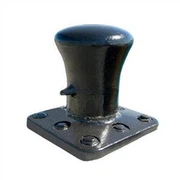
Single Bitt Bollards, as one kind of dock bollards, often referred to as US Style Pillar bollards are particularly suitable for applications where tidal range variations are large and can handle steep mooring line angles.

Cleat Bollards are used in work boat berths and marinas around the world. They are created with the same care, modern design methods and choice of materials as their larger cousins. Mooring Cleats can be supplied with suitable fixing hardware for either new dock or marina with cast-in-anchors or.

Terminal Mooring Bollard T Head
"Tee Bollard", "T-bollard", this design has a top shaped like a "T". Hence, the name. Very prominent in many parts of the world due to its simplicity and it gets the job done well up to 200 tonnes.

The Double Bitt Bollard carries on where the Single Bitt bollard leaves off, allowing neighboring vessels to moor cleanly on the same bollard. The angled heads are ideal for Spring lines. The Double Bitt Bollard's small footprint will fit even when space is at a premium.

Marine bollards are a simple and cost-effective way to fulfill mooring requirements and safely secure vessels alongside jetties, berths, wharves, and dolphins in ports and harbors.

Grade: AM2,AM3 Anchor Chain & Accessories
Size: 16mm - 187mm
Standard: ISO-1704-2007,IACSW18,W22,API-2F(U.S.A),Approved by 11 international class,such as ABS,DNV,BV,LR...

25% weight reduction compared to conventional anchors; excellent performance in a variety of soils.
An anchor is a device, normally made of metal, used to secure a vessel to the bed of a body of water to prevent the craft from drifting due to wind or current. The word derives from Latin ancora, which itself comes from the Greek.
Anchors can either be temporary or permanent. Permanent anchors are used in the creation of a mooring, and are rarely moved; a specialist service is normally needed to move or maintain them. Vessels carry one or more temporary anchors, which may be of different designs and weights.
A sea anchor is a drag device, not in contact with the seabed, used to minimise drift of a vessel relative to the water. A drogue is a drag device used to slow or help steer a vessel running before a storm in a following or overtaking sea, or when crossing a bar in a breaking sea.
Benefits of Anchor
Efficient weight/holding power ratio: Anchors have the most efficient weight/holding power ratio for steel anchors.
Excellent initial setting: Anchors have the likelihood to set in the most challenging bottoms – hard-packed clay/mud and grassy/weedy areas, even packed gravel.
Superior holding power: Anchors provide the best holding power relative to their size and weight. This means that you can use a lighter anchor to achieve the same or more holding for your boat.
Immediate resetting: Anchors reset immediately with a new pulling direction in case of wind or current change.
Easy retrieval: Anchors are lightweight and easy to retrieve. They will arrive at your roll bar perfectly aligned, never upside down, and will be maneuvered easily even when stuck with your neighbor's boat chain.
Easy to store: Taking apart the anchor will only take 5 minutes, and while stowed away, the anchor will take minimal storage space.
Easy to handle: Anchors are so easy to handle with or without a windlass, making them a perfect choice for single-handed bluewater sailors.
Types of Anchor
Mushroom anchor
Very large mushroom anchors are used for moorings or securing buoys. Small mushroom anchors may be effective in the softest river bottom but have minimal holding power. They should be used only for personal watercrafts, small aluminum fishing boats, or dinghies.
Danforth or fluke anchor
This style of anchor is a good choice for smaller boats because it folds flat and is easy to stow, and has great holding power for its weight. Its wide, sharp flukes sink into sand and hard-mud bottoms, but are less effective in deep mud or a grassy bottom. If the wind shifts and boat drifts over the anchor and then in the opposite direction from which it was set, a Danforth anchor can pull free.
Plow anchor
A plow anchor is a little more cumbersome than a Danforth, and is a good choice if the anchor is secured on a bow roller rather than in an anchor locker in the boat. A plow anchor has a single penetrating point and is more likely to reset itself if boat position changes. It can be more effective than the Danforth in light grass, has the strength to hold in a rocky bottom if it gets a good grip, and does well in soft bottoms.
Claw anchor
This non-folding anchor is similar to the plow anchor, but has a broader scoop shape that works well in mud, clay or sandy bottoms. These anchors are also strong enough to hold on a rocky bottom. A claw anchor will re-set quickly if the wind changes. It may not work well on a very hard bottom, or in thick vegetation, both challenging for all types of anchors. This anchor is also best-suited to installation with a bow roller or windlass.
Grapnel anchor
Shaped like a grappling hook, this anchor has multiple tines or points, and is designed to grab onto structure on the bottom-such as rocks or submerged timber-rather than sink into the bottom. The tines usually fold up along the shank so that the anchor is more compact for stowage. On some models the tines are designed to bend to make it easier to retrieve the anchor if it becomes snagged on bottom structure. The tines can them be bent back into shape. Grapnel anchors are available in many sizes, including very small models for jon boats, skiffs or small boats, like kayaks.
Box anchor
The Box Anchor is an innovative anchor design known for its ease of use and ability to set quickly in various seabed conditions. Its unique, collapsible box-like shape allows it to fold flat for convenient storage and deployment. Boaters appreciate the Box Anchor for its effectiveness in sandy and muddy bottoms and its reliable holding power in windy and turbulent conditions. This anchor's setting process involves dropping it into the water and letting it naturally orient itself, making it a user-friendly choice for boaters of all experience levels. The Box Anchor's versatility and quick-setting capabilities have made it a popular option for both inland and offshore use. However, it's worth noting that the Box Anchor may be less effective in rocky or weedy bottoms, so boaters should assess the anchoring environment before choosing this anchor type.
Navy anchor
The Navy Anchor, or the Stockless Anchor, is a traditional and time-tested design widely used in maritime applications for many years. This anchor type features a sturdy, non-folding design with a shank and flukes that stick out straight from it. Navy Anchors are known for their reliability and stability when set, making them a preferred choice for larger vessels, including commercial ships and naval vessels. They excel in holding power, especially in soft or muddy seabeds, making them ideal for anchoring in ports and harbors. While they may not be the most lightweight or compact option, Navy Anchors are prized for their ability to provide secure anchoring in a wide range of conditions, which is why they continue to be a popular choice in the boating world.
River anchor
The River Anchor is a specialized anchor designed for use in river and freshwater environments. Its unique design includes wide, flat flukes with multiple sharp points to help the anchor grip the riverbed effectively. River Anchors are typically chosen by boaters navigating inland waterways, such as rivers, lakes, and quiet streams. They excel in maintaining a secure hold in soft riverbeds, preventing boats from drifting due to current or wind. Boaters who enjoy fishing, picnicking, or leisurely cruising in freshwater often opt for River Anchors to ensure a stable and worry-free experience. These anchors are generally more lightweight and manageable than their larger, offshore counterparts, making them well-suited for smaller boats used in recreational boating.
Ring or hook: This serves as the point of attachment of the anchor to the anchor chain or cable. It is generally located at the uppermost point of the anchor.
Shank: It is the central, axial and vertical long part of the anchor running from the ring to the lower part of the arms. This part comprises a large amount of weight and this helps in better entombing of the anchor to the seabed or floor while the vessel is intended to be positioned.
Crown: The lowermost rounded, arc-shaped section of the anchor rests in the seabed and connects the arms to the central shaft. This extends in both sides, forming the arms. The shank is directly fitted to the crown and often forms a ball-and-socket joint capable of making a 30 or 45-degree rotation.
Arms: The lower projections of the anchor extend in either direction from the crown and contributes significantly to the grip. For better grasp, curved arms became increasingly popular since the early 19th century and hence, straight arms seldom exist.
Fluke: This is the flat shield-like part that constitutes the tip end of the arms extending in both directions and plays a very important role in fastening themselves to the seafloor by digging or clinging to the bottom mud or rocky elements. Flukes are sharp in nature for better penetration. Most modern anchors are characteristic of fluke which may be of different efficient shapes, and such anchor types are known as fluked anchors (see below).
Throat: The curved inner extension of the arm where it joins the shank.
Balancing band: It is a sleeve-like structure fitted near the centre of the shank such that the anchor balances itself horizontally during lifting operations.
Stock: The stock was chiefly used in older designs like the Admiralty type anchors since their advent in the 17th and 18th centuries. These are also known as stocked anchors. The stock is basically like a shaft that passes through the topmost point of the shank in a perpendicular direction to the arms and acts as a screw that turns itself so that one of the arms and flukes digs itself properly into the seabed. However, one major difficulty faced by stocked anchors is their difficulty to bestow. Thus, most modern designs are stockless.
Chain cable: The function of a chain cable is lowering and hauling back the anchor to and from the seabed based on the requirement as well as maintaining mechanical stability when the vessel is desired to be anchored at a particular location. The chain cable of an anchor comprises studded or interlocked steel links over its entire length also known as shackles. The studs or shackles are reinforced by a locking pin. The entire chain cable arrangement is considerably heavy and thus while anchorage, their self-weights also contribute significantly to the positioning of the vessel along with, of course, the principal component of tension.
Hawse pipe: This helps in guiding the chain cable arrangement from the deck level to the outside of the shell plating while lowering or hauling up the anchor. The boring of this pipe should be sufficient enough for the smooth and unhindered function of the chain cable without any chance of obstruction, clogging or damage.
Chain stopper: The chain stopper acts as intermediate support and guides for the chain between the windlass and the hawse pipe. Thus, while pulling or lowering the chain cable, the stopper helps in directing the arrangement properly to or from the hawse pipe. The stoppers are of considerable strength and are designed to withstand and absorb both the weight as well as the high tensile loads from the chain during operation. Commonly, chain stoppers have a roller-like arrangement for guiding the cable arrangement and lessen frictional loads to be counteracted by the windlass.
Material of Anchor
Stainless steel
Stainless steel anchors have a bright, shiny appearance, making them the best-looking anchor option for your boat. They are also exceptionally strong and naturally resist corrosion. If appearance, strength and longevity matter to you in a boat anchor, stainless steel might be your best option for material.
The only downsides to stainless steel are its cost and potential for getting scratched. Of the three main types of anchor materials, stainless steel is the most expensive. Many boaters feel the appearance and strength of these anchors justify the price. However, use caution to protect the anchor's appearance. Scratches on the surface will quickly mar its naturally shiny exterior.
Galvanized steel
Galvanizing steel creates a corrosion-resistant coating. Since steel does not naturally prevent rust or corrosion, all types of steel anchors, unless made of stainless steel, should undergo galvanization.
Galvanized steel can start with either mild steel or high-tensile steel. You must know which types of steel you get because there are significant differences in performance, despite their similar appearance. Mild steel may only be half as strong as high-tensile steel. Though the strength does not directly relate to the holding power, you still want a strong steel core when choosing a galvanized anchor.
Galvanized steel has the same holding capability as stainless steel. The former does not look nearly as good as the latter, though. If cost is a factor, galvanized steel costs much less than stainless steel or aluminum. However, you will have to occasionally retreat it with galvanization as the coating wears off. Plus, the anchor won't look as sleek as a stainless-steel model.
Aluminum
Aluminum anchors are the lightest weight options available, making them easy to use onboard and ideal for ultralight sailboats. These high-strength anchors depend on their ability to dig into the bottom for a good hold.
While light in weight, aluminum anchors tend to cost a lot. These are a pricier option than either galvanized steel or stainless steel. Choose aluminum if the anchor's weight is the most important factor.
● Regularly inspect the anchor, anchor chain or rope, anchor windlass, and other related components for signs of wear, corrosion, or damage. Check for any loose or missing bolts, nuts, or fasteners. If any issues are detected, address them promptly and repair or replace components as needed.
● Clean the anchor, anchor chain, rope, and anchor windlass regularly to remove dirt, debris, and saltwater residue. This helps prevent corrosion and ensures smooth operation. Lubricate moving parts of the anchor windlass, such as gears, bearings, and pawls, with marine-grade lubricants according to the manufacturer's recommendations.
● Check the anchor chain or rope for signs of wear, including rust, kinks, or fraying. Replace any worn or damaged sections of the chain or rope to ensure its strength and reliability. Make sure the chain or rope is properly secured to the anchor and windlass.
● Test the anchor windlass to ensure it is operating smoothly and effectively. Check the motor, controls, and safety features, such as the clutch and brake, for proper functioning. If any issues are detected, repair or replace the windlass as needed.
● When not in use, store the anchor properly to prevent damage and corrosion. Avoid leaving the anchor in saltwater for extended periods and rinse it thoroughly with fresh water after each use. Store the anchor chain or rope in a dry and well-ventilated area to prevent mold, mildew, and corrosion.
● Keep track of the anchor holding performance during anchoring operations. If the anchor is dragging or not holding properly, consider repositioning or resetting it to ensure adequate holding power. Be mindful of changing weather and sea conditions that may affect anchor holding.

Modern anchors have a chain near the anchor followed by lighter cable or rope up to the vessel. The anchor chain helps give added weight so the anchor can be set with horizontal force to dig in and stay put. The captain should "set" the anchor by applying reverse power to make sure the anchor digs in and won't go anywhere. Proper setting ensures that the boat actually stays and doesn't drift off course. Recommended length of rope and chain is 7x depth.
Strength: All anchors are rated by their holding power, or their strength to hold a boat in place considering factors like water conditions, bottom conditions, the size of your boat, wind and weather conditions and other factors that will impact the anchor. An anchor will dig into a seabed or lake bed and is secured by the material at the bottom and a weighted rope, chain or other materials above.
Weight: The size and weight of your anchor should correlate with the size and weight of your boat and the conditions you operate your vessel in. How long do you plan to anchor? Are you operating your boat in a calm lake or choppy sea? These factors and more are considerations for an anchor's weight. If you're deciding between two different anchors, it's often best to choose the larger one so you know your boat will be secure in case of rough waters or rocky seabeds.
Bottom conditions: The water's bottom conditions are crucial to the effectiveness of an anchor. All anchor styles work best in specific bottom conditions. An anchor needs to create resistance to secure the boat - its ability to dig or penetrate the seabed or lake bed determines its resistance. The types of bottom conditions include mud, sand, rocks, grass or clay.
Setting an anchor is critical to a boat's safety. If you're at anchor and the wind picks up, or a storm comes in, you need to be sure your anchor will hold. Here are some tips on how to set an anchor properly.
● First, choose the right spot. You'll want to find a place with a good holding ground – somewhere with a sandy bottom or grassy seabed is ideal. Avoid areas with rocky outcroppings or reefs, as your anchor could get snagged.
● Next, drop your anchor. Let out enough rope so that it's about five times the depth of the water – this will ensure that your anchor has a good grip.
● Once your anchor is down, start backing up slowly. This will help set the anchor in place.
● Finally, secure the rope to your boat. You can do this by tying it off to a cleat or using a special device called an anchor rode locker.
By following these steps, you can be sure that your anchor will hold fast in even the strongest of winds or waves.
Our Factory
Our factory located besides the beautiful and ancient Beijing-Hangzhou Grand Canal with convenient transportation, east to Beijing-Shanghai highway, south to Yangtai airport. Our company established in 2004, is a professional enterprise for designing and manufacturing all kinds of marine fenders and other rubber products for more than forty years. We have the advanced technique, mature production craft, and own the reliable quality.


Our Certificate


FAQ
Hot Tags: anchor, China anchor manufacturers, suppliers, factory, High Performance Arch Fender, Rubber Water stop Belt, V Type Fender, Marine Accommodation Ladder, High Performance Arch Rubber Fender, mooring equipment for vessels


Send Inquiry
