Mooring Bollard Types And Uses Explained
Jul 21, 2026

In ports, terminals, shipyards, and offshore engineering projects, mooring bollards are among the most fundamental and critical mooring equipment. Whether for small workboats, container vessels, large oil tankers, or bulk carriers, mooring bollards are essential for securing ropes to shore structures-ensuring vessel stability and safety during berthing.
While mooring bollards may appear structurally simple, different types vary significantly in load capacity, rope arrangement flexibility, applicable vessel types, and installation environments. Poor selection during the design phase can lead to uneven rope tension, reduced mooring efficiency, and even compromise long-term terminal safety.
This article systematically introduces common mooring bollard types and their applications to help you better understand the differences between products.
The Role of Mooring Bollards in Ports
On the surface, a mooring bollard seems like a simple steel component for securing ropes-but it performs vital safety functions.
After berthing, vessels typically deploy multiple rope groups including head lines, stern lines, breast lines, and spring lines to restrict longitudinal movement, lateral drift, and rotation. All rope tension ultimately concentrates on the mooring bollards.
If bollards are poorly designed, underspecified, or improperly installed, consequences may include:
- Uneven rope tension distribution
- Reduced mooring efficiency
- Structural damage to equipment
- Increased berthing safety risks
- Terminal operation disruptions
Thus, in modern port design, mooring bollards are no longer mere accessories but key components influencing overall terminal safety ratings.
T Head Mooring Bollard
The T Head Mooring Bollard is one of the most widely used types in international port construction projects. Its top features a crossbeam structure resembling the letter "T," providing a large contact area for ropes and allowing multi-directional rope arrangements-making it ideal for large commercial and industrial terminals.

Key Advantages:
- More uniform rope tension distribution
- Accommodates multiple ropes simultaneously
- Reduces rope slippage risk
- Suitable for complex mooring conditions
- Wide range of load capacities
|
Rated Load |
Typical Applications |
|
25T–50T |
Small terminals |
|
50T–100T |
General commercial ports |
|
100T–200T |
Container terminals |
|
200T+ |
Deep-water ports & large energy terminals |
Cleat Bollard
Cleat Bollards are commonly used in berthing areas for small-to-medium vessels, such as marinas, fishing ports, and inland waterway terminals. Their structure resembles traditional marine cleats, with two protruding arms for rope wrapping and securing.
Compared to heavy-duty bollards in industrial terminals, Cleat Bollards are compact, space-efficient, cost-effective, and easy to install-even in confined quayside spaces.

Key Advantages:
- Simple structure with low manufacturing and installation costs
- Small footprint, ideal for compact terminal layouts
- Minimal routine maintenance
- Suitable for light-to-medium load conditions
- Easy operation for frequent berthing/unberthing
Typical Applications:
- Marinas
- Fishing ports
- Inland ports
- Small commercial berths
- Floating pontoons & recreational vessel berthing areas
For small-to-medium vessels, Cleat Bollards meet daily mooring needs. However, larger commercial vessels or high-load scenarios require higher-capacity bollard types.
Single Bitt Bollard
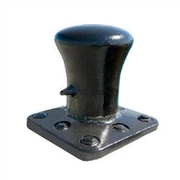
The Single Bitt Bollard is a traditional mooring device consisting of a single cylindrical post. Its simple, mature manufacturing process made it popular in early terminals and inland facilities. Ropes wrap directly around the post.
While limited in rope management and multi-directional load handling, it remains an economical solution for low-load projects.

Key Advantages:
- Compact structure with minimal installation space
- Low manufacturing and maintenance costs
- Simple foundation requirements
- Suitable for light or medium-light load conditions
- Ideal for single-rope or limited-rope operations
Common Applications:
- Small terminals
- Inland waterway terminals
- Temporary berths
- Auxiliary docking areas
- Small workboat berths
As ports scale up, Single Bitt Bollards are less common in major commercial harbors but remain relevant in smaller terminals and inland shipping.
Double Bitt Bollard
The Double Bitt Bollard features two parallel posts, enabling simultaneous securing of multiple ropes and effective load distribution. Compared to single-post designs, it offers superior load performance and operational flexibility.
Its ability to accommodate larger rope diameters and complex mooring configurations makes it widely used in heavy-duty terminals and large vessel berths.

Key Advantages:
- High load capacity
- Supports multiple ropes simultaneously
- Improved rope distribution
- Strong resistance to eccentric loads
- Suitable for complex mooring conditions
Typical Applications:
- Heavy industrial terminals
- Bulk cargo terminals
- Ore terminals
- Energy terminals
- Offshore platforms and marine facilities
For berths serving large vessels with high mooring forces, Double Bitt Bollards provide stable load performance and higher safety margins-remaining a preferred choice for many heavy-duty port projects.
How to Choose the Right Mooring Bollard?
In practical engineering, bollard selection requires comprehensive consideration of multiple factors.
Vessel Size and Tonnage
Larger vessels generate higher mooring forces. Vessel type is the primary selection criterion:
- Yachts: Typically require 10T–25T bollards
- Workboats: May require 50T bollards
- Container ships: Usually require 100T+ bollards
- VLCCs: May require 200T+ bollards
Design Mooring Load
Rated bollard load is not determined solely by vessel tonnage but calculated based on design mooring force, considering:
- Maximum wind speed
- Current velocity
- Wave conditions
- Vessel windage area
- Mooring arrangement plan
Terminal Structure Conditions
Different terminal structures require tailored installation methods:
- Gravity quay walls
- Sheet pile wharves
- Pile-supported wharves
- Floating pontoons
Each structure demands specific foundation design solutions.
Operating Environment
Corrosion in marine environments cannot be ignored. Common materials include:
|
Material |
Characteristics |
|
Ductile iron |
Lower cost |
|
Cast steel |
High strength |
|
Stainless steel |
Excellent corrosion resistance |
|
Special alloy steel |
Suitable for extreme environments |
Conclusion
As critical infrastructure in ports and offshore engineering, mooring bollards directly impact vessel berthing safety and terminal operational efficiency. Each bollard type offers distinct advantages in structure, load capacity, and application. There is no universally "best" product-only the most suitable choice for your project's specific needs.
When planning port construction, terminal upgrades, or offshore projects, thorough understanding of bollard types-combined with scientific selection based on vessel profile, design loads, environmental conditions, and budget-ensures safer, more reliable long-term performance.
Looking for high-quality mooring bollards or expert selection advice for your port project? Contact Shanghai Mountains today. We provide professional mooring bollard solutions and customized services tailored to vessel types, load requirements, and project specifications-helping your project operate safely and efficiently.